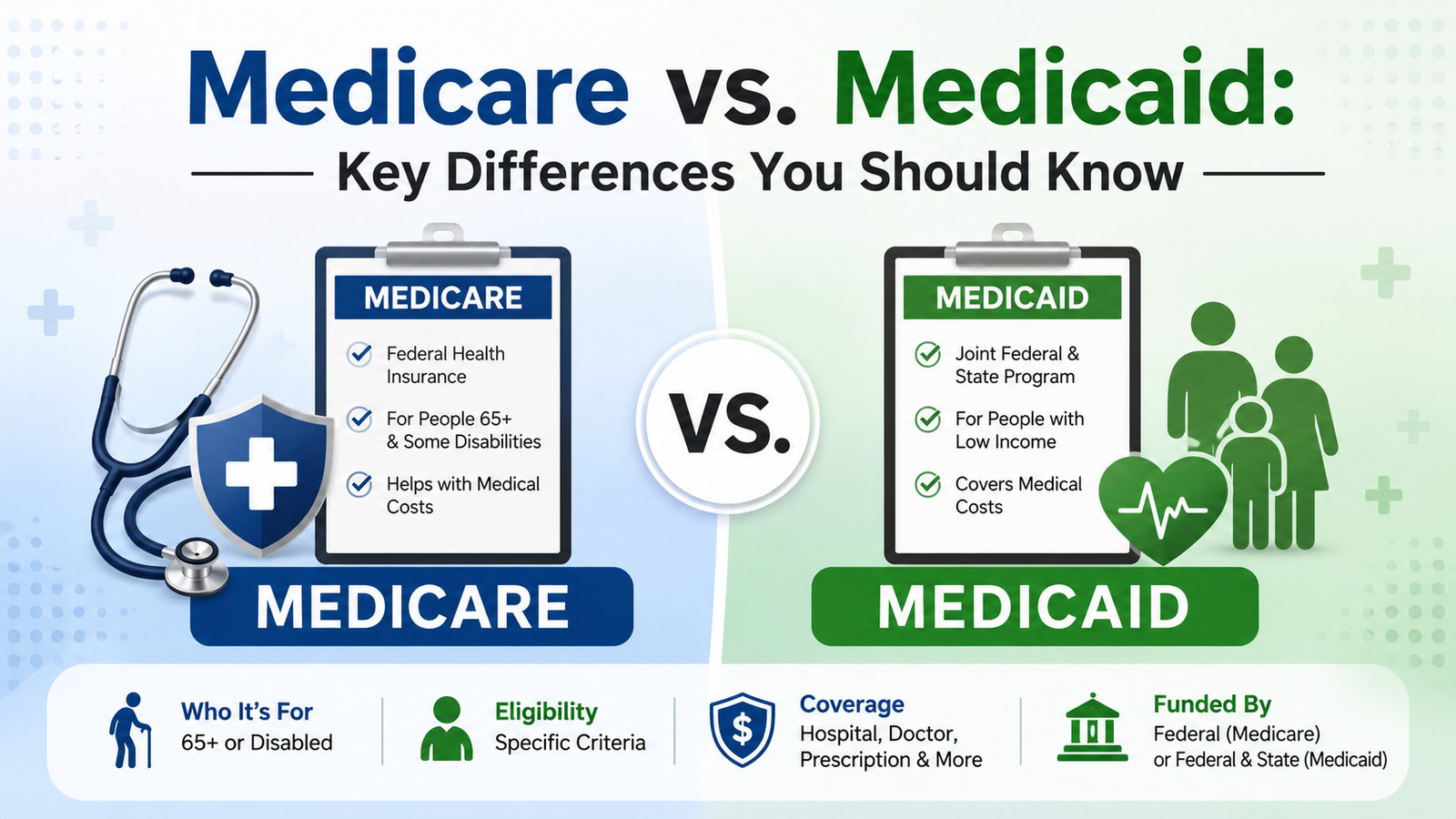
When navigating the U.S. healthcare system, two government programs often cause confusion: Medicare and Medicaid. Although both programs help people access healthcare and are funded through government sources, they serve different populations and have different eligibility rules, coverage options, and costs.
Understanding the difference between Medicare and Medicaid is important if you are approaching retirement, have a disability, have a limited income, or are helping a family member choose the right healthcare coverage. This guide explains the key differences between Medicare and Medicaid in simple terms.
What Is Medicare?
Medicare is a federal health insurance program primarily designed for people who are 65 or older. Certain younger individuals may also qualify if they have specific disabilities or certain serious medical conditions.
Medicare eligibility is generally based on age or disability, rather than household income. Many people become eligible for Medicare when they turn 65, although enrollment rules and premium requirements can vary depending on an individual’s work history and circumstances.
Medicare is divided into several parts:
- Part A: Helps cover inpatient hospital care, skilled nursing facility care in qualifying situations, hospice care, and some home healthcare.
- Part B: Covers medically necessary services such as doctor visits, outpatient care, preventive services, and certain medical equipment.
- Part C: Also called Medicare Advantage, these are private health plans approved by Medicare that provide Medicare-covered benefits and may offer additional benefits.
- Part D: Helps pay for prescription medications through private plans approved by Medicare.
Medicare beneficiaries generally have premiums, deductibles, copayments, or coinsurance depending on the coverage they choose and the services they use.
What Is Medicaid?
Medicaid is a joint federal and state program that provides healthcare coverage to eligible individuals and families with limited income and, depending on state rules, other qualifying circumstances.
Unlike Medicare, Medicaid eligibility is strongly connected to income and financial resources, although eligibility categories differ by state. Medicaid can cover children, pregnant women, parents, older adults, people with disabilities, and other eligible groups.
Because Medicaid is administered jointly by federal and state governments, the specific eligibility requirements and covered services can vary considerably from one state to another.
Medicaid may cover services that Medicare does not generally cover, including certain types of long-term care. For people who qualify, Medicaid can also provide substantial assistance with healthcare expenses, sometimes with little or no out-of-pocket cost.
Medicare vs. Medicaid: The Main Difference
The simplest way to remember the difference is this:
Medicare is mainly based on age or disability, while Medicaid is primarily based on financial eligibility and other qualifying circumstances.
For example, a 70-year-old retiree may qualify for Medicare regardless of whether they have a low or high income. On the other hand, a younger adult with limited income may potentially qualify for Medicaid if they meet the requirements established by their state.
The programs can also overlap. Some people qualify for both Medicare and Medicaid. These individuals are often referred to as “dual eligible.” When someone qualifies for both programs, Medicaid may help with certain Medicare premiums and cost-sharing expenses, depending on the person’s eligibility and state rules.
Key Differences in Eligibility
Medicare eligibility is generally straightforward for people who meet the age requirement. Individuals under 65 may qualify through certain disability-related pathways or specific medical conditions.
Medicaid eligibility is more complicated because it depends on factors such as income, household size, age, disability status, pregnancy, and state-specific rules. Some states have expanded Medicaid eligibility for certain adults, while others have different requirements.
This means that someone who qualifies for Medicaid in one state may not necessarily qualify under identical circumstances in another state.
Differences in Costs
Costs are another major distinction.
Medicare is not automatically free for everyone. Depending on the situation, beneficiaries may pay monthly premiums, deductibles, copayments, and coinsurance. The amount a person pays can depend on the Medicare part they use, their income, and whether they choose Original Medicare or Medicare Advantage.
Medicaid generally has lower out-of-pocket costs for eligible beneficiaries. Some services may require small copayments, but federal and state rules limit how much eligible individuals can be charged for covered services.
For people with limited financial resources, Medicaid can therefore provide significant financial protection against healthcare expenses.
Differences in Coverage
Both programs cover a wide range of healthcare services, but their coverage is not identical.
Medicare focuses heavily on hospital care, physician services, outpatient treatment, preventive care, and prescription drug coverage through its various parts.
Medicaid may provide a broader range of services depending on the state. In some circumstances, Medicaid can help cover long-term nursing facility care and other services that Medicare generally does not cover for extended periods.
This distinction is especially important for older adults who may eventually need long-term care. Medicare and Medicaid should not be viewed as interchangeable programs because their rules and benefits are fundamentally different.
Can You Have Both Medicare and Medicaid?
Yes. Some individuals qualify for both programs.
For example, an older adult may qualify for Medicare because of their age and also meet Medicaid’s financial eligibility requirements. In this situation, Medicare generally serves as the primary health coverage, while Medicaid may help with certain healthcare costs and services based on the individual’s eligibility.
Having both programs can significantly reduce healthcare expenses, but the exact benefits depend on the person’s circumstances and state Medicaid rules.
Which Program Is Right for You?
The answer depends primarily on your personal circumstances.
If you are 65 or older, Medicare is likely to be the main government health insurance program you should investigate. If you are younger but have a qualifying disability or certain medical condition, Medicare may also be available.
If you have a limited income and meet your state’s eligibility requirements, Medicaid may be an option.
It is also important to remember that healthcare needs change over time. A person who does not qualify for Medicaid today may become eligible later if their income or circumstances change. Likewise, someone enrolled in Medicare may become eligible for Medicaid assistance in the future.
Final Thoughts
Medicare and Medicaid are both essential parts of the U.S. healthcare system, but they serve different purposes. Medicare primarily provides health coverage based on age or certain disabilities, while Medicaid provides healthcare assistance primarily based on financial eligibility and other qualifying factors.
The biggest differences involve who qualifies, how eligibility is determined, what services are covered, and how much beneficiaries may have to pay.
Understanding these distinctions can help you make more informed healthcare decisions. If you are approaching age 65, managing a disability, living on a limited income, or caring for an aging family member, it may be worthwhile to review your eligibility and compare the coverage options available to you.
Because Medicare and Medicaid rules can change and Medicaid requirements vary by state, always check the latest official program information before making an enrollment or coverage decision. Your healthcare needs, income, age, and location can all affect which programs and benefits are available to you.